
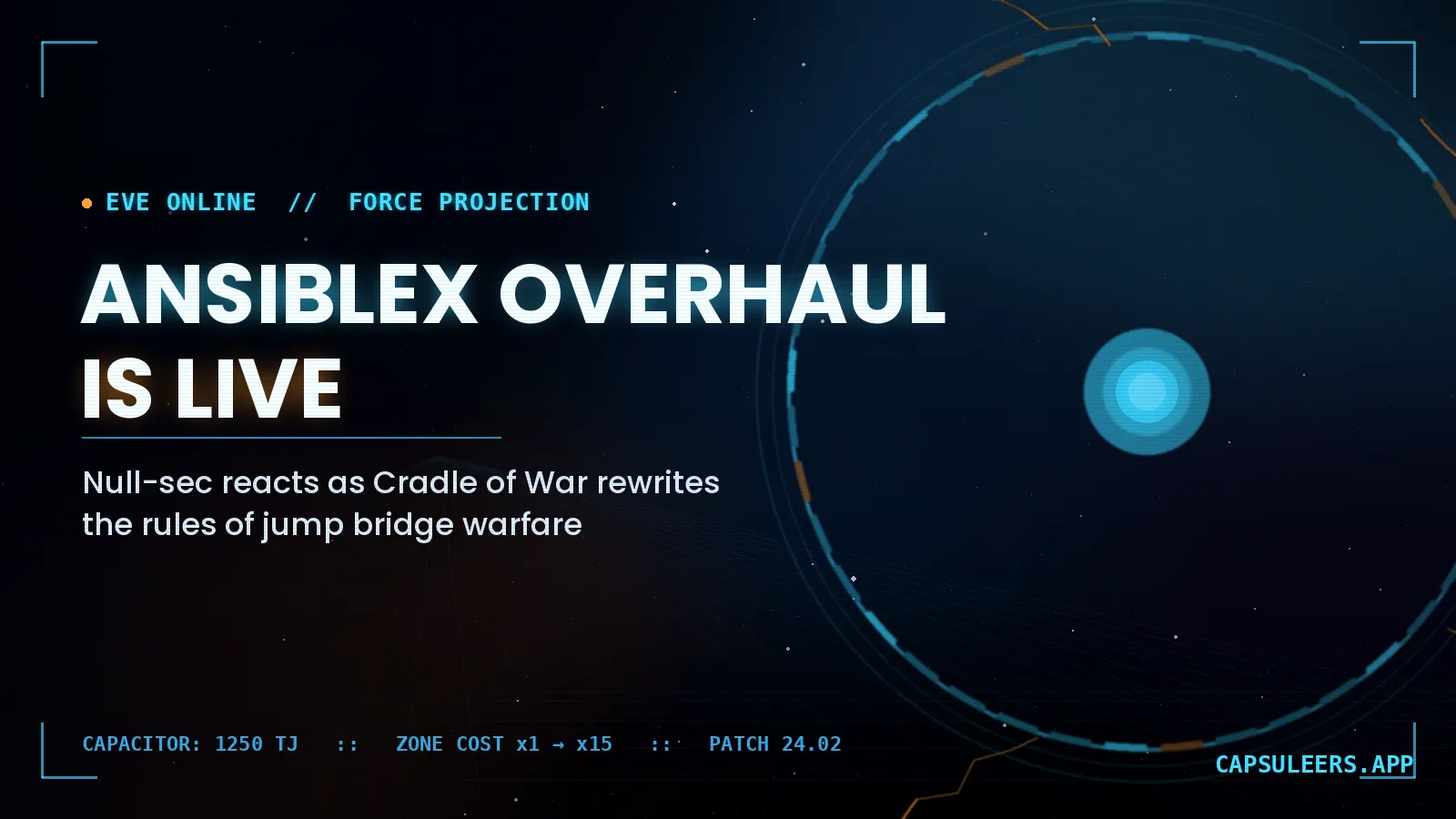

The rework that Fenris Creations previewed earlier this month is no longer a dev blog — it's live. As of September 22, every Ansiblex jump bridge in New Eden runs on a hard capacitor limit, and the bill for using one now depends on how far a pilot is jumping from their alliance's home system. It's the biggest structural change to force projection in years, and going by the first wave of forum posts, null-sec isn't convinced it's the fix anyone asked for.
What Actually Changed at the Gates
Every Ansiblex now carries its own capacitor pool, separate from the ships that use it. Once that pool runs dry, the gate stops working until it recharges — there's no way to force a jump through an empty bridge.
Total capacity: 1,250 TJ per gate
Recharge rate: roughly 200 TJ per hour, on a non-linear curve similar to a ship's capacitor (recharges faster in the mid-range than near empty or full)
Full recharge from empty: about 6 hours 15 minutes
What a jump actually costs depends on two things: the ship, and the distance from the owning alliance's declared capital system.
Distance zones and their cost multiplier:
Zone | Range from capital | Multiplier |
|---|---|---|
1 | 0–5 ly | ×0 (free) |
2 | 5.1–10 ly | ×2 |
3 | 10.1–15 ly | ×6 |
4 | 15.1–20 ly | ×9 |
5 | 20.1+ ly | ×15 |
Base capacitor cost by ship class (before the zone multiplier is applied):
Ship type | Base cost |
|---|---|
Capsules, haulers, freighters, exhumers | 1 TJ |
Frigates | 4 TJ |
Cruisers | 10 TJ |
Battleships | 16.5 TJ |
Black Ops | 18 TJ |
Marauders | 19 TJ |
Rorquals | 19 TJ |
The two numbers multiply together, so a cruiser jumping into Zone 3 territory costs 60 TJ (10 × 6) out of that gate's 1,250 TJ pool — meaning a single Ansiblex can only absorb so much fleet traffic before pilots are waiting on the recharge timer.
On top of the capacitor system, three access changes landed alongside it:
Subcapitals only. Capitals and supercapitals can no longer use Ansiblex gates at all.
Alliance-only ACLs. Access lists can no longer be opened to coalition partners — only members of the owning alliance can use the gate.
Longer capital relocation cooldown. Changing an alliance's declared capital system now locks for 90 days, closing the option of shifting the free-travel zone on demand.
Why Fenris Creations Made the Call
Game Design Director FC Okami has been the public face of this rework since the original "Future of Force Projection" dev blog, and the framing hasn't changed: force projection — the ability of large alliances to throw overwhelming firepower anywhere on the map within minutes — has been one of the most persistent complaints from smaller alliances and roaming groups for years.
The distance-scaling logic is explicit about what it's trying to do. As Fenris Creations put it in the update announcement: "Moving forces outward toward the edges of an alliance's reach becomes progressively more expensive, while returning toward its center costs considerably less." In other words, defending home territory stays cheap; projecting power to the edge of a sprawling coalition's holdings gets expensive fast.
Fenris Creations says the design was shaped by feedback gathered through the Council of Stellar Management, the Factional Warfare Parliament, and the Wormhole UN community group, and has committed to monitoring the changes on a biweekly basis with further iteration planned — both for force projection and for sovereignty mechanics more broadly.
The Rest of Cradle of War Shipped Today Too
The Ansiblex rework is the headline change, but it's bundled into a much bigger update, and the rest of the patch is worth knowing about:
Pirate Insurgencies got faster progression, with shorter FOB reinforcement cycles, a new battlecruiser-focused combat site with skill bonuses, and more of the rewards now tied to actually winning an engagement outright rather than just participating.
Wormhole combat in Class 1–3 systems was modernized: NPC AI now uses electronic warfare, capsuleers can run energy neutralizers against NPCs for the first time, and sites got visual and objective-tracking improvements.
Pochven adjustments include Vigilance Points scaling up to 12 pilots (with payouts adjusted accordingly), Observatory Flashpoints scaling down from 15 to 12 pilots, and new mutaplasmids for drone support modules.
Ship balance: Marauders and black ops battleships got a mass reduction (useful for wormhole mass limits), heavy assault cruisers regained medium railgun range, and lancer dreadnoughts picked up stronger resistances.
Info panel can now track up to five achievements at once.
Fenris Creations is also running limited-time packs — PLEX bundles and skill-training offers aimed at new wormhole and Insurgency pilots — available through October 5.
[Suggested visual: screenshot from the official Cradle of War patch notes page, or an in-game shot of the new wormhole combat site / Pochven Vigilance Point]
Null-Sec's Early Verdict: Mixed to Hostile
The reaction on the EVE Online forums since launch has leaned negative, and the criticism is mostly aimed at one change: alliance-only Ansiblex access.
The core argument is that restricting ACLs to alliance members punishes exactly the structure — coalitions of allied but independent alliances — that lets smaller groups hold territory without merging into a mega-alliance. One forum reply summed up the worry bluntly: restricting Ansiblex ACLs "seriously harmed the concept of coalitions" and could ultimately "result in a collapse of sov-holding entities." Several players argue the change will push exactly the opposite of Fenris Creations' stated goal — instead of giving small alliances more room to operate independently, it may pressure them to fold into larger blocs just to keep shared jump bridge access.
There's also a practical question that's come up repeatedly and hasn't been fully answered yet: what happens to an existing Ansiblex that bridges two allied alliances' territory? Does it simply stop working for the non-owning side, or does it become one-directional? Players are asking for clarification before passing final judgment.
Not everyone is up in arms — some replies on Steam's community forums were simply positive or neutral, and a few longtime players welcomed the change as overdue, with one commenting the fix arrived "ten years too late" rather than too early. But on the official forums' general feedback thread for the patch, the volume of criticism around coalition logistics and bridge access has been the dominant theme so far, alongside a long list of smaller UI and quality-of-life complaints unrelated to force projection itself.
What to Watch Next
Fenris Creations has been explicit that this isn't the final word — Okami's team has committed to reviewing the numbers on a biweekly cadence, and further sovereignty-related changes are already flagged as coming in future updates. The open questions worth tracking:
Whether the alliance-only ACL restriction gets adjusted or clarified for coalition-shared structures.
How quickly null-sec's major coalitions adapt their logistics chains to the new capacitor limits — and whether that shows up in territorial shifts over the next few weeks.
Whether the capacitor and distance numbers themselves get tuned once Fenris Creations has real usage data from the first patch cycle.
Given how sensitive null-sec's current territorial map already is — with several coalitions actively losing or consolidating ground this month — a change this large to how fast anyone can reinforce a border is likely to show up in the next round of sovereignty reports either way.