

On 29 September 2026 Fenris Creations published a dev blog called Keeping Memories Alive. The subtitle sums it up nicely: NPC agents have a long memory, but can it be moved to Python 3?
It sounds like pure back-end housekeeping, and mostly it is. But this one has a small piece of homework for players, so it is worth a few minutes.
Where this comes from: the move to Python 3
Some context first. In August Fenris Creations announced that the move to Python 3 has begun. EVE's server code, roughly 2.4 million lines of it, has run on Python 2.7 since 2010, and Python 2.7 reached end of life in 2020. The stated goal is that the migration should be "completely unnoticeable, aside from the occasional moment when something runs more smoothly." The first stage, making the code compatible with both versions, went out on 25 August. If you want the background from the people building it, the Talk Python To Me podcast dedicated an episode to it: Episode #564, EVE Online Departs for Python 3.
The agent memory post is one of the pieces of that puzzle that cannot be solved by simply "making the code compatible".
The problem: memories stored as sealed boxes
Every time you talk to an agent, the game needs to remember where you are with them: an active mission, a research task, a locator job, storyline progress, the state of an epic arc. According to the dev blog, this system handles around 100,000 missions per day.
The catch is how that information is stored. Agent memory is saved as a Python "pickled" object, a serialized blob written straight into the SQL database. Fenris Creations points out two problems with that:
You cannot search inside it. The database sees an opaque chunk of binary data, so it cannot be queried efficiently.
Python 3 cannot read what Python 2 wrote. Without a migration, the old data would eventually become unreadable, which means permanent data loss.
The fix: a three-phase migration
The team is moving agent memory to a new, readable format in three phases:
Phase 1: the game keeps loading the legacy data while the new format is validated.
Phase 2: the new format takes priority, with the legacy one as a fallback.
Phase 3: the legacy format is discontinued entirely.
Since the blog went live, all new or updated memories are saved in both formats at the same time.
What it means for you
Fenris Creations is clear on the important part: your NPC standings are safe, and agents you have already unlocked stay accessible. If you run missions regularly, you should not notice anything.
The exception is inactive characters. Old, unfinished missions attached to characters that never touch them again may be cleared when Phase 3 completes, and the blog frames that timeline as months rather than days. To keep them, the post asks players to interact with their research agents at least once after 29 September 2026. Some one-time content, such as tutorials and epic arcs, will be migrated automatically whatever the character does. Any clearing will come with advance notice.
If you keep alts parked with long research or mission chains you care about, logging them in and talking to the agent once is a cheap precaution.
Why it matters beyond agents
This is a small change with a bigger message. Moving from opaque blobs to a searchable format means the data becomes something the developers can actually inspect and query, and that is the kind of groundwork that the wider Python 3 effort is meant to deliver: better tooling, easier bug fixing and a codebase that can support new features. It also fits the pattern of the last few weeks, where Fenris Creations has been shipping both visible gameplay changes with the Cradle of War update and the invisible plumbing underneath.
Gallery and resources
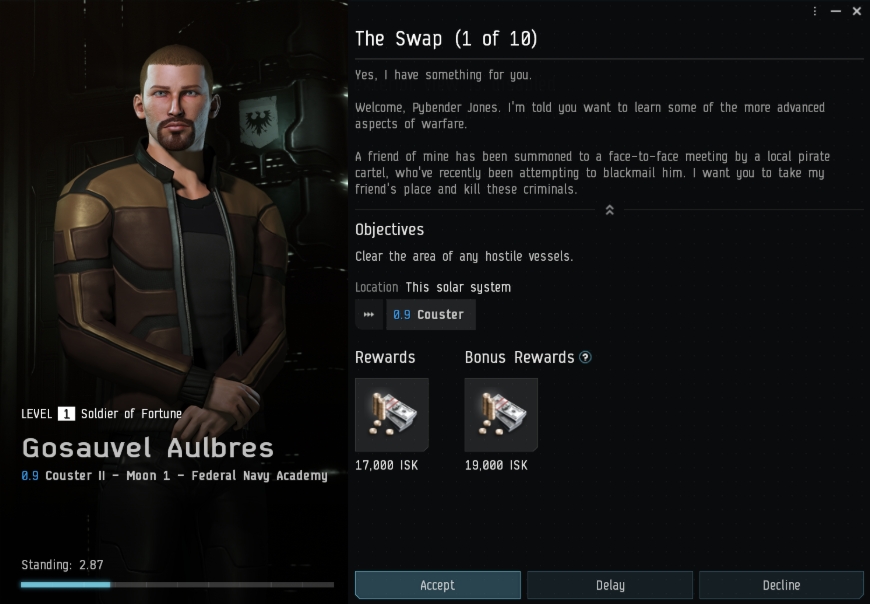
Screenshot of an agent interaction from the dev blog:
Podcast (audio/video): https://talkpython.fm/episodes/show/564/eve-online-departs-for-python-3